Thought-provoking Things Worth Sharing - Issue #183
Has Employee Engagement Bottomed-Out?

According to Gallup, employee engagement has declined since 2020, but it remained at the same low level between 2024 and 2025. Maybe we’ve reached peak disengagement?
It’s still pretty bleak, though:
Between 2020 and 2025, younger U.S. workers experienced the largest drops in engagement. The percentage of Generation Z and younger millennials who are engaged at work dropped by eight points, while older millennials (born 1980 to 1988) dropped by nine points. Generation X declined in engagement by six points, and baby boomers saw no change in engagement since 2020.
Welcome to this week’s collection of thought-provoking things. For each issue, I will share information about careers and workplace culture, mental health in the workplace, talent development, and key insights into privacy, security, and legal technology.
You can learn more about me here: Mike McBride Online.
Using 2020 as the starting point is interesting. Remember in the early days of the pandemic, when employers and politicians talked about how we were in this together, and they were finding unique ways to work remotely, fund solutions for people who couldn’t work, and applauded the folks who still showed up in essential jobs to make sure we were as safe as we could be, but still taken care of?
What happened to those leaders? Where did they go?
I think these two charts say it all when it comes to how younger workers feel about the workplace now:
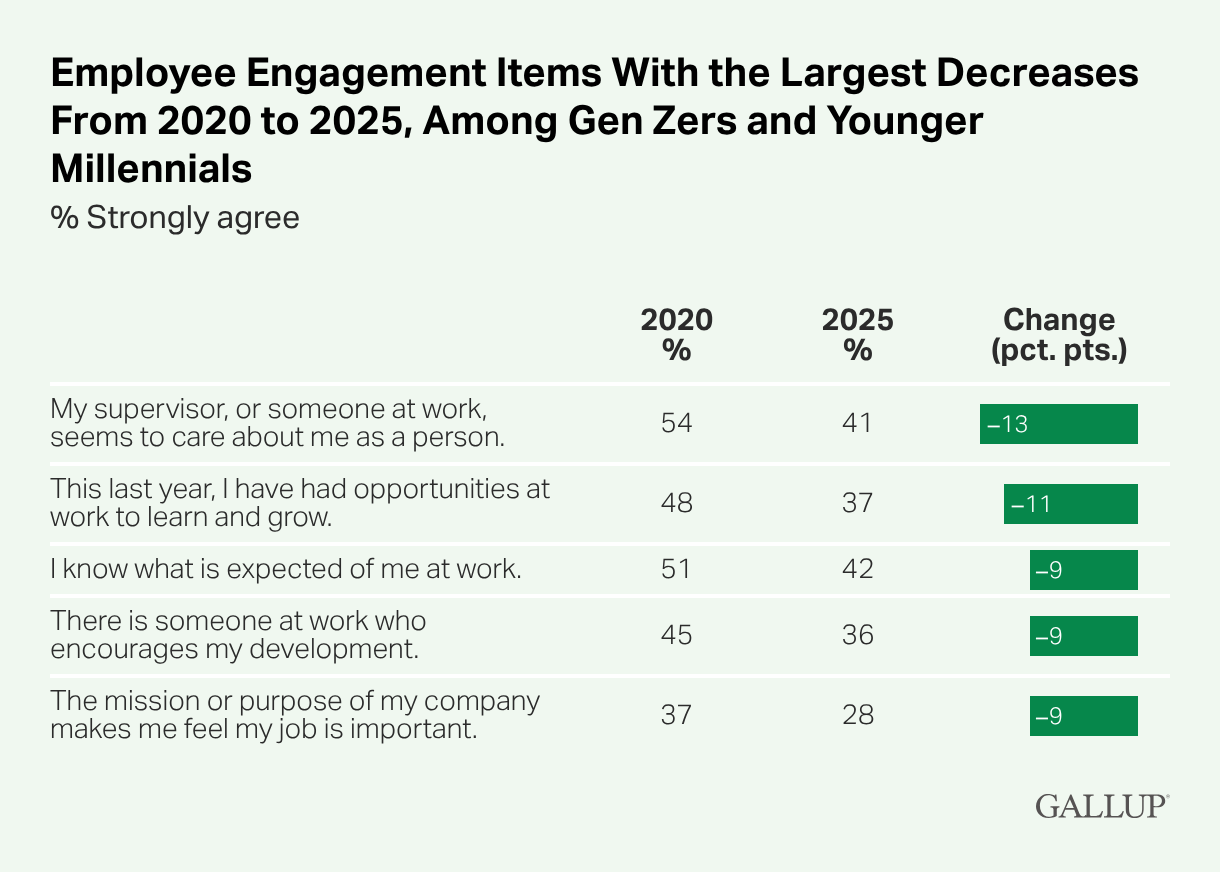
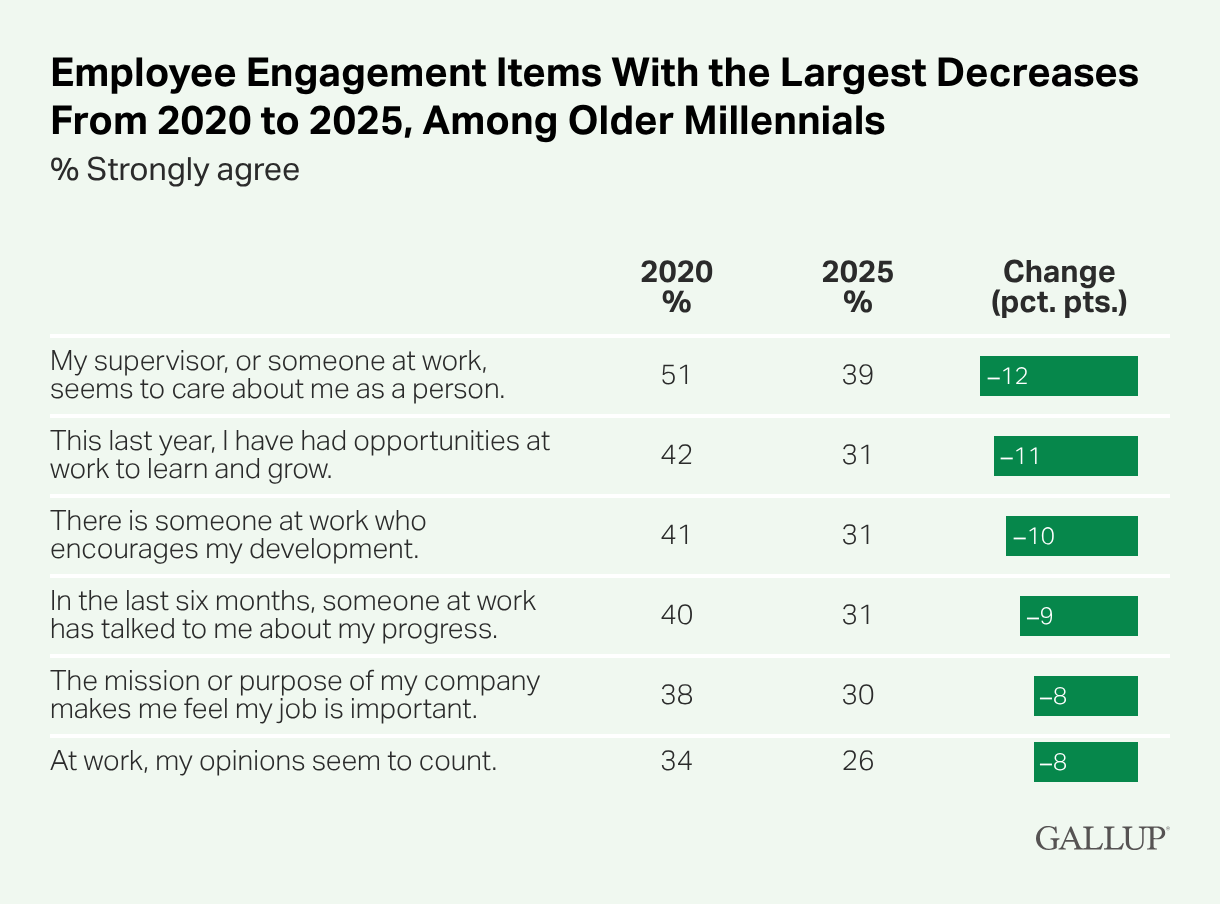
We just quit giving a crap about people, and it shows. I guess these young folks should just be glad to have a job, but that mindset isn’t leadership. I don’t know what it is, but it won't convince anyone to give you their best work.
How do we get leaders to see these charts and understand that this is a problem?
Careers and the Workplace
How much burnout is this popular workplace advice causing? - The Hidden Cost of “Doing More with Less” in IT
I’d also argue that it’s not hidden.
Show Your Work, and You Might Get Lucky
The post is written by a developer, and he’s got good advice for anyone looking for that kind of work. I’m not a developer, but I can say with some confidence that this advice applies to everyone. In this job market, who you know is everything.
Scratch that. It’s not who you know, it’s who knows you and your work. The more people who see your work, the more likely you are to land a job. It’s not always that simple, but it sure increases the odds. Maybe for the rest of us, it’s not about having a GitHub repository for our projects, but about writing a blog, being involved in user groups, or volunteering with your industry’s educational resource.
Artificial Intelligence
Worth Reading - General Purpose AI Will Never Be Safe
I think we can agree that granting someone full access to the open internet without education or tools to protect themselves would be dangerous, no?
OK, but what is a general-purpose LLM but a collection of everything that the model could ingest, without rules about what was safe and what wasn’t?
Yet we expect people to use them, and aren’t making any effort to make them safer.
This seems bad - AI Use + Data Security: A Growing Gap
survey of 921 IT and cybersecurity professionals finds that although 83% of enterprises “already use AI in daily operations…only 13% report strong visibility into how it is being used.”
Worth Reading - How Malinformation Tricks Your Brain
The article above, however, makes it clear that our brains take shortcuts to make quick decisions. In doing so, the number of times we see something that isn’t true can impact whether we treat it as false or true. They say familiarity breeds contempt when it comes to other people, but maybe familiarity with shared information breeds acceptance, regardless of the truth.
That is frightening in a world where tens of thousands of posts can be created in minutes.
Training and Development
Teaching employees to use AI could add up to $6.6T to US economy
This is a problem, however:
Meanwhile, an October report from Express Employment Professionals and Harris Poll found that although 72% of hiring managers said their companies are using AI, more than half also said their organizations don’t have the resources to train their employees how to use it effectively.
I agree, but I also don’t see it happening - Why Mental Health Training for Managers Is a Non-Negotiable Today
Mental Health in the Workplace
Worth Reading - “Pizza Parties Don’t Fix Burnout”: The State of Librarian Mental Health
It’s exhausting to go to work every day for people who refuse to stand behind you as a human being and treat you like an expense they would do anything to be rid of.
Sadly, that is the state of the workplace for many people. It’s not just at the library, and it won’t be fixed by pizza, yoga, or any other lunchtime activity.
Worth Reading - Fake news and trust
This is the instruction manual. Make everything seem dangerous and chaotic, then offer simplistic fixes and explanations that aren’t true at all, but fit a narrative you wish to manipulate people with. As Seth describes, the easy thing to do is to accept those explanations and stop thinking about it much further. We are hard-wired to do that. We’ve been educated to do that. We’ve been told simplistic lies like the world is fair, and good things happen to good people, and we believe it because the truth is much less comfortable.
We’ve all done this math - The mental math of taking time off
Privacy, Security, and Legal Tech
Worth Reading – Carvana and the New Hyperlink Fight: “Contemporaneous” Isn’t Automatic—It’s Earned
As someone responding to an eDiscovery request, the flip side of that statement is, of course, true. Kelly goes into some detail, but for my M365 folks: if you're going to argue that the version of the document when shared is too difficult to collect, you will need to show your work. That will need to include a whole lot more than saying you don't know how to do it, or that it's difficult.
This seems relevant to lawyers this year - Effective Advocacy 101 in the Age of eDiscovery and AI: A Guide for Lawyers and Their Clients.
Agents automate lots of things, including the actions that we would consider an insider threat:

You know I’m a huge RSS fan, so much so that I pay for a Feedly Pro account. (I pay for the larger number of feeds and the ability to turn an email address (one I subscribe to newsletters with) into a feed I can read in Feedly.
If you aren’t yet that dedicated to RSS feeds, this may be a super-easy way to get started. It’s free, you don’t even need an account, the data is stored in your browser, or you can create a free account and sync the data across your devices.
That’s all, folks. If you found something interesting in this week’s newsletter, please share it with your friends. It’s the best way to help support the effort I put into sharing this with you each week.